Program Overview
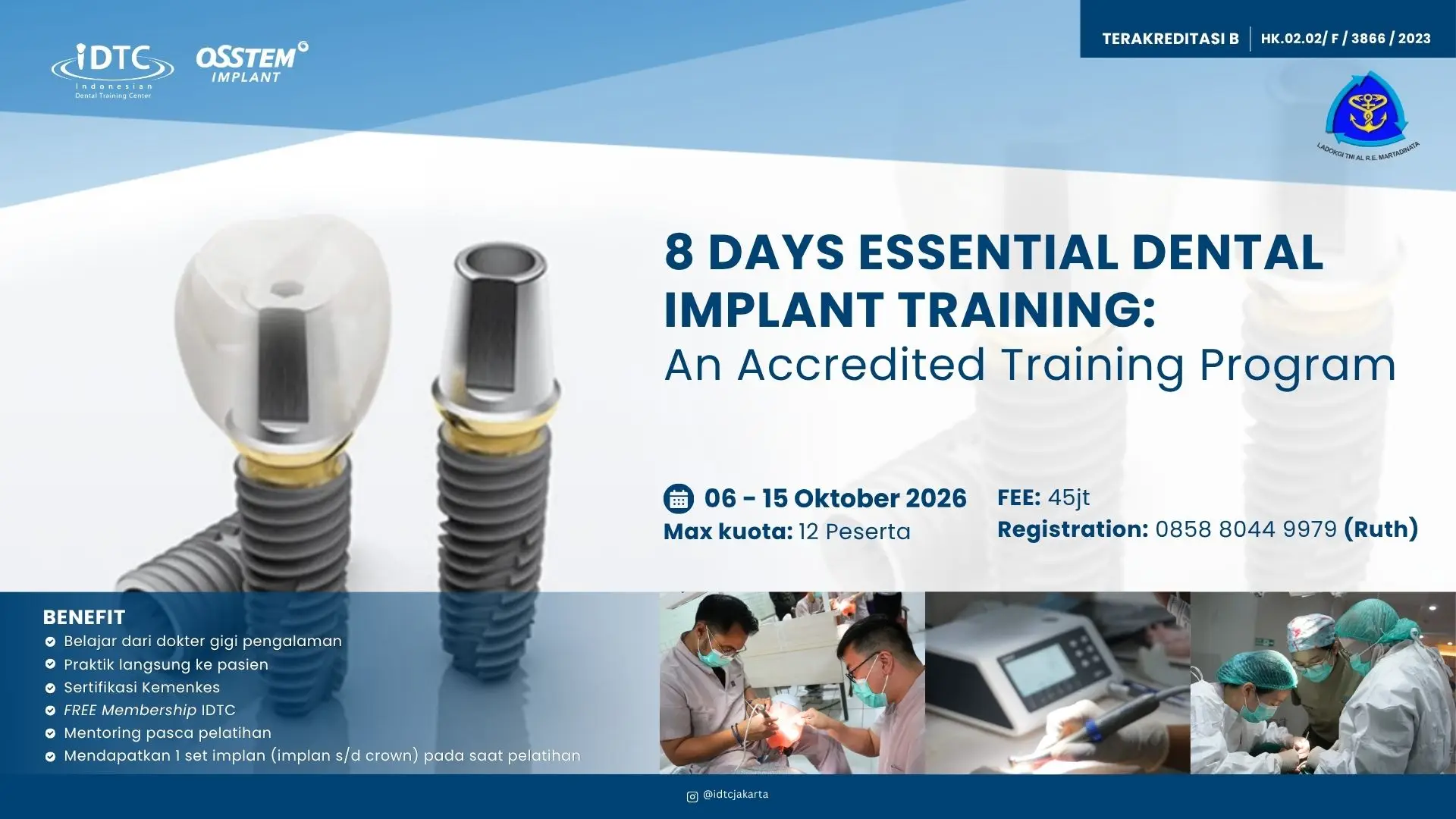
The Basic Implant Course is a comprehensive, two-phase training program designed to take general practitioner (GP) dentists from zero prior implant experience to full clinical competency from surgical implant placement through to final prosthetic restoration. Unlike model-only or theory-based courses, participants gain direct hands-on experience treating real patients at every critical stage, under full mentor supervision. Upon completion, participants receive official certification from the Indonesian Ministry of Health (Kemenkes), giving their competency formal legal recognition for implant practice.
The program is structured in two phases, spaced roughly five months apart, allowing participants to safely progress from surgical placement to osseointegration to final prosthetic delivery mirroring the real clinical timeline of an implant case.
Learning Objectives
Upon successful completion of this program, participants will be able to:
Ethics, Legal Foundations & Clinical Science
– Apply the ethical, legal, and regulatory framework governing implant treatment for GP dentists in Indonesia.
– Explain the anatomical, biological, functional, and biomechanical considerations underlying dental implant treatment.
Assessment & Treatment Planning
– Perform a comprehensive clinical assessment prior to implant surgery.
– Interpret radiographic findings and bone analysis for implant planning.
– Complete medical records and use study models to inform treatment planning.
Surgical Placement
– Execute the preparation, instrumentation, and step-by-step procedure for implant placement.
– Place implants and perform suturing with confidence, first on study models and then on patients.
– Conduct clinical and radiographic evaluation following implant placement.
Prosthetic Restoration
– Place healing abutments accurately, first on models and then on patients.
– Take precise impressions for implant-supported restorations, first on models and then on patients.
– Deliver and insert the final crown on patients, completing the case end-to-end.
Course Curriculum
Phase 1 Surgical Placement (8 Days)
- Ethics, Regulation & Clinical Foundations
– Ethics, legal considerations, and regulations of implant treatment for GP dentists
– Anatomical, biological, functional, and biomechanical considerations in dental implants - Clinical Assessment & Planning
– Comprehensive clinical assessment before dental implant surgery + hands-on
– Radiology assessment and bone analysis for implant planning: what to check before surgery
– Understanding medical records and models for better implant planning - Surgical Basics & Placement
– Implant surgery basics: preparation, instruments, and procedures + hands-on
– Placing implants and suturing: step-by-step + hands-on
– Clinical and radiographic assessment after implant placement + hands-on - Case Study & Treatment Planning
– Biomechanics and pre-treatment assessment: dental implant case report study
– Filling records and creating treatment plans based on study models - Hands-On: Surgical Technique on Models
– Hands-on: surgical instruments and incision techniques on study models
– Hands-on: implant fixture installation and wound closure on models - Hands-On: Records & Planning
– Hands-on: recording, examining, and model preparation for implants
– Hands-on: study models, radiographic review, and treatment planning - Live Patient Surgery
– Performing implant surgery on patients, under mentor supervision - Post-Surgical Evaluation
– Clinical and radiographic evaluation
- Ethics, Regulation & Clinical Foundations
A healing period of approximately six months follows, allowing osseointegration before the prosthetic phase begins.
Phase 2 Prosthetic Restoration (~6 Months Later)
- Hands-on: healing abutment placement on models
- Hands-on: impression-taking on models
- Healing abutment placement on patients
- Impression-taking on patients
- Crown insertion on patients
Participants who complete both phases receive official certification from the Indonesian Ministry of Health (Kemenkes), recognizing their competency to perform basic implant treatment — from surgical placement through prosthetic restoration.
COURSE FEE
